Bottled Speed: What CFD Testing Reveals About the Fastest Hydration Setups
| December 04 2025Hydration isn’t optional. Aerodynamics isn’t optional. But anyone who has tried to balance both knows how tricky it is: where you place your bottles can make your bike faster… or meaningfully slower.
Recently, we came across an exceptionally detailed thread on the Slowtwitch Forum titled “Bottle Positions CFD Tested: Bottled Speed” (January 2025). The author — a CFD specialist who has worked with Team USA — shared a deep dive into how different water-bottle positions affect drag. You can read the full original discussion here: Bottle Positions CFD Tested: Bottled Speed on Slowtwitch .
The testing and explanations were so insightful that we wanted to summarise the findings, highlight key takeaways, and add some practical commentary for real-world athletes.
Why Bottle Placement Matters More Than You Think
Every bottle you carry interrupts airflow. Traditionally, athletes assume that adding bottles increases drag — but the Slowtwitch CFD tests challenge that assumption. In several cases, certain bottle setups actually reduced drag compared to having no bottle at all.
For time-trialists and triathletes, this can be the difference between a personal best and a missed target.
How the Testing Was Done
The author performed Computational Fluid Dynamics (CFD) simulations using a high-fidelity rider model wearing a time-trial helmet. Notably:
- No bike frame or bottle cages were included — the study focused purely on rider and bottle interaction.
- The simulation was validated against known wind-tunnel data.
- Multiple bottle positions were tested, including:
- Front bottles (between-the-arms / BTA)
- Rear bottles (various heights, distances, and angles around the rider’s back)
The baseline “no bottle” scenario produced a drag area of roughly CdA ~0.222 m² — a number typical for professional-level time trial setups.
Key Findings
1. Front Bottles Were Universally Faster Than No Bottle
Every front-mounted bottle reduced drag compared to the baseline. This is counter-intuitive, but the explanation makes sense:
- The bottle fills in the turbulent pocket between the forearms, smoothing airflow.
- It functions like a fairing — legal because it’s a hydration device, not an aero device.
This means a BTA bottle isn’t just convenient — it could actually be aero-positive.
.jpg)
2. Rear Bottles Can Be Big Aero Wins — If Placed in the Right Spot
Some rear positions added drag, but the optimal ones were significantly faster:
- Positioned low on the back
- Close to the rider’s body
- Preferably in a horizontal orientation
- Similar to carrying a bottle in a low jersey pocket
The best-case scenario simulated could save up to two minutes over an Ironman bike leg compared to a poorly placed bottle or no rear bottle at all.
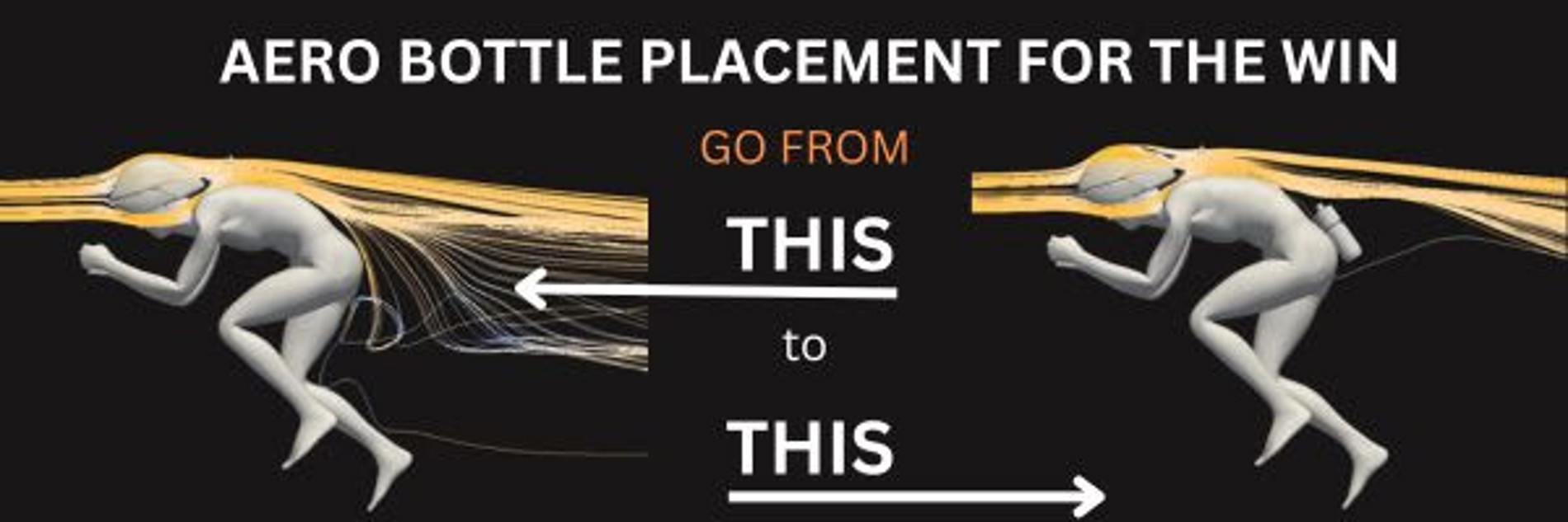
Why? Because a bottle placed tight to the lower back acts like a “spoiler”. It forces airflow to detach cleanly rather than wrapping under the rider and creating lift and induced drag — both of which slow you down.
.jpg)
Why These Results Make Aerodynamic Sense
Airflow behind a cyclist is messy. As it rolls off the back, it:
- bends downward,
- generates turbulence,
- creates lift,
- and expands the wake — increasing drag.
A well-placed rear bottle helps to “tidy up” this airflow, reducing the chaotic wake. Meanwhile, a front bottle helps align airflow between the arms and reduces separation.
Aerodynamics is often surprising — and this is one of those times.
Caveats: Why You Should Interpret Results Carefully
The original author emphasised limitations clearly, and it’s worth repeating them:
- No bike frame was modelled. Frames dramatically affect bottle placement options.
- “Floating” bottle positions may not be mechanically possible on a real bike.
- CFD does not always equal real-world behaviour.
- Movement, crosswinds, bottle cages, frame shapes, and rider posture all matter and can change how a given setup actually performs.
- Some experienced testers have noted that CFD gains don’t always map directly to field or wind-tunnel testing.
In other words: these results give direction — not guaranteed rules.
Practical Takeaways for Real-World Riders
If you want free speed without compromising hydration, consider the following:
Use a Between-the-Arms (BTA) Front Bottle
It’s practically always fast or at least neutral — and the CFD suggests it’s often aero-positive. - Check out our range here
If You Use Rear Bottles, Rethink the Classic “Behind the Saddle, Upright” Setup
Traditional behind-the-saddle cages can sit too far back from the rider and increase drag.
Place Rear Bottles Lower and Closer to Your Back
Aim for something closer to “low jersey-pocket height,” angled horizontally, and as close to the body as is practical and legal within race rules. - Check out range of products here
When in Doubt, Test
Even simple outdoor testing — consistent route, steady power, and careful timing — can help validate what’s fastest for your position and your bike. If you have access to aero sensors or a wind tunnel, even better.
Conclusion
The Slowtwitch “Bottled Speed” CFD analysis is a fantastic example of the cycling community sharing high-value data that challenges our assumptions. It suggests that hydration can be optimised not just for convenience, but for performance — sometimes even delivering unexpected aero gains.
A massive thank-you to the original author for sharing such detailed analysis and opening up the conversation. For those who want to dive into the full discussion, the thread is here: Bottle Positions CFD Tested: Bottled Speed on Slowtwitch .
As always, treat CFD as a starting point — and let your own testing determine what’s truly fastest for you.
Want further help with what's best for you, your set up and your goals, pop in and see us in store or call us on 01455 558951